Welcome back to the Digest

If you have spent any time with us here at CFS Dental Division, you know we do not believe in blanket advising. There is no single malpractice policy that fits every dentist, and there is definitely no single policy that fits every state. California is a good example of why.
Most dentists think of professional liability coverage as one national product you buy once and forget about. In practice, how a claim unfolds depends enormously on where the treatment happened. So let's take a step back and walk through what makes California its own conversation, in plain English, the way we would if you were sitting across from us.
MICRA, and the shift that is still in motion
California has long been known for the Medical Injury Compensation Reform Act, usually shortened to MICRA. For decades, MICRA placed a fixed ceiling on noneconomic damages, which is the category covering pain and suffering rather than measurable financial loss. That number sat unchanged for a very long time, and it is widely credited with keeping professional liability costs in California more moderate than in a number of other states.
That framework changed through legislation that took effect in 2023. Instead of one fixed figure, the cap now steps upward on an annual schedule running into the 2030s, with separate amounts for cases involving a patient's death and cases that do not. Economic damages, meaning things like the cost of corrective treatment or lost income, were never capped under MICRA in the first place.
Here is the part that matters for you. The ceiling on one category of damages is higher than it used to be, and it is scheduled to keep climbing. Carriers know this. It is one of several reasons why limits that felt generous when you first opened your doors may deserve a second look now. The specific figures move year to year, so we always confirm the current numbers before we help a client make a decision rather than quoting something from memory.
How long a California patient generally has to file
California uses a two part timing rule for claims against health care providers, and licensed dentists fall inside that definition. Broadly speaking, a patient generally has one year from the point they discover the injury and its suspected cause, or three years from the date of the injury itself, whichever comes first. There are exceptions, including situations involving minors, alleged concealment, or a foreign object.
California also has a pre filing notice requirement, where a patient is generally expected to give written notice before starting an action. We have had more than one client call us about a letter like that sitting on their desk for a week because they were not sure what it was. If something like that ever arrives, it belongs in your carrier's hands quickly. Not in a drawer, and not in a pile of statements.
Why does this matter for your insurance? Because the shape of that filing window determines how long your exposure lingers after a patient walks out the door. That feeds directly into whether a claims made policy needs supporting tail coverage, and for how long.
So is coverage actually required in California?
This is where dentists get conflicting answers, and honestly, for good reason. California does not impose one universal malpractice insurance mandate on every licensed dentist the way some states do for certain professions. But several overlapping requirements tend to create the obligation anyway:
- Professional dental corporations are generally subject to security for claims provisions, which are commonly satisfied through professional liability insurance at specified minimums.
- Participation in certain public payer programs typically carries its own minimum coverage requirements.
- Hospital or surgery center privileges, DSO and group affiliations, associate agreements, equipment financing, and commercial leases frequently require evidence of coverage at stated limits.
- Practice sale and transition agreements often require proof of prior acts coverage or a purchased tail.
The result is that most California practice owners carry coverage not because one statute forces the issue, but because the contracts wrapped around their practice do. Those requirements change as your relationships change, which is exactly why we like reviewing contracts and coverage together instead of one at a time.
Not sure what your contracts actually require?
Send us your declarations page and your associate or lease agreement and our team will read them side by side with you. No cost, no obligation, and no assumption that you should already know this. Reach out through our contact page to get that started.
Limits are only half the story
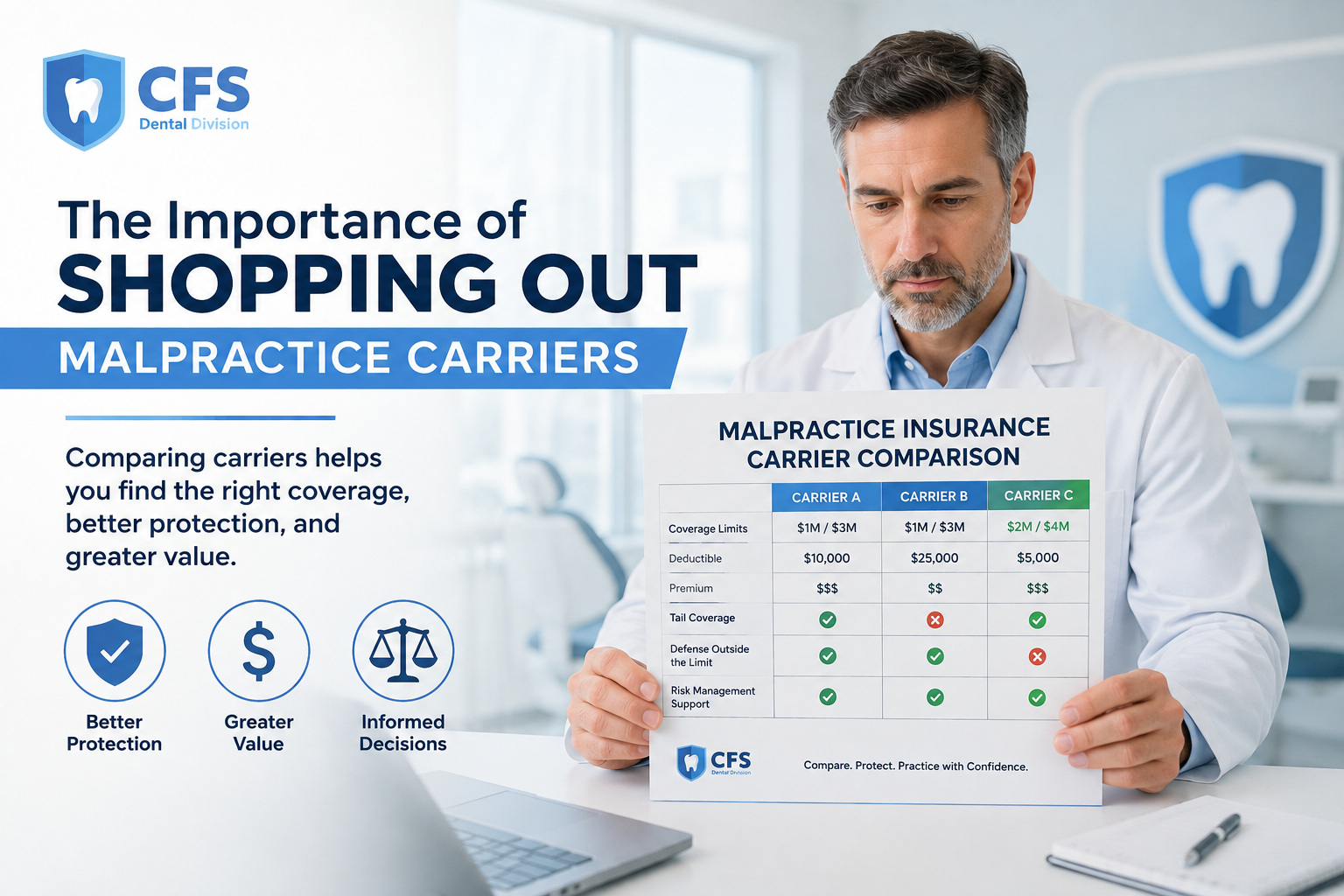
Two policies can show the same number on the declarations page and behave completely differently when something goes wrong. These are the details we spend the most time on with clients:
Whether defense costs sit inside or outside the limit. If legal defense eats away at the same pool of money available for a settlement, a long defense quietly shrinks your protection.
Shared versus separate limits. In a group practice, a shared aggregate can be consumed by someone else's claim. Separate limits per provider generally behave differently.
Consent to settle.
Some policies give you meaningful say in whether a claim is settled. Some do not. Reportable settlements can carry consequences that go well beyond the dollars.
License defense and regulatory coverage. A board complaint runs on a separate track from a civil lawsuit, and the two do not always move on the same timeline. Some policies include an allowance for administrative defense, and the amounts vary a lot.
Carrier financial strength. We look at ratings from groups such as AM Best and Moody's for a reason. A carrier needs the balance sheet to stand behind a serious claim, not just an attractive quote.
Where California claims tend to come from
Procedure mix drives risk far more than geography does. Implant placement, third molar extractions, endodontic treatment, sedation, orthodontic outcomes, and cosmetic cases are the areas most often associated with claims across the profession. A practice offering sedation or expanded surgical services will face different underwriting questions than one focused on restorative and preventive care.
Documentation is the other recurring theme, and it is the one you control. Informed consent records, updated medical histories, imaging, and clear notes about alternatives and refusals matter enormously when a claim gets evaluated. Insurance responds to a claim. Your documentation shapes how that claim gets defended.
A review rhythm that actually works
Malpractice coverage is not a set it and forget it item, but it does not need to be a monthly worry either. Most of our California clients revisit it when something changes: adding a procedure category, hiring an associate, bringing sedation in house, opening a second location, changing entity structure, buying or selling, or heading toward retirement. In a stable year, an annual look at limits, policy type, and contract requirements is usually enough.
If you cannot answer the questions above about your own policy, that is a completely normal place to start. Most dentists were handed a policy at some point in their career and have never revisited the structure since. That is not a failure. It is just what happens when you are busy running a practice.
Let's look at yours
CFS Dental Division works exclusively with dental professionals, which means we can start with your procedure mix, your contracts, and your stage of practice instead of a generic questionnaire. Whether you are a resident about to sign your first associate agreement or an owner five years from a transition, the conversation should be built around your situation.
Ready to talk it through? Visit our contact page to schedule a coverage review with our team, or explore our malpractice insurance page to see how we approach it. You can also reach us directly at info@cfsdentaldivision.com.
Disclaimer
This article is provided for general informational and educational purposes only. It is not legal, tax, or insurance advice, and it does not describe or guarantee the terms of any specific policy. Insurance products, state requirements, statutes, and regulations change over time and vary by carrier and by individual circumstance. Coverage is subject to the terms, conditions, exclusions, and limits of the policy actually issued. Please consult a licensed insurance professional and, where appropriate, qualified legal counsel before making decisions about your coverage.
In 5 Seconds
California's damages framework under MICRA has been changing on a scheduled basis, which can affect how much coverage feels appropriate.
- The state's filing window is generally short but has exceptions, and that shapes how long your exposure lasts after treatment.
- Coverage is usually driven by contracts, corporate structure, and payer participation rather than one statewide mandate.
- Policy structure matters as much as the limit: defense costs, shared limits, consent to settle, and carrier strength.
- Review your coverage whenever the practice changes, and let our team help you read the fine print.
Questions about your California coverage? Contact CFS Dental Division and we will walk through it with you.